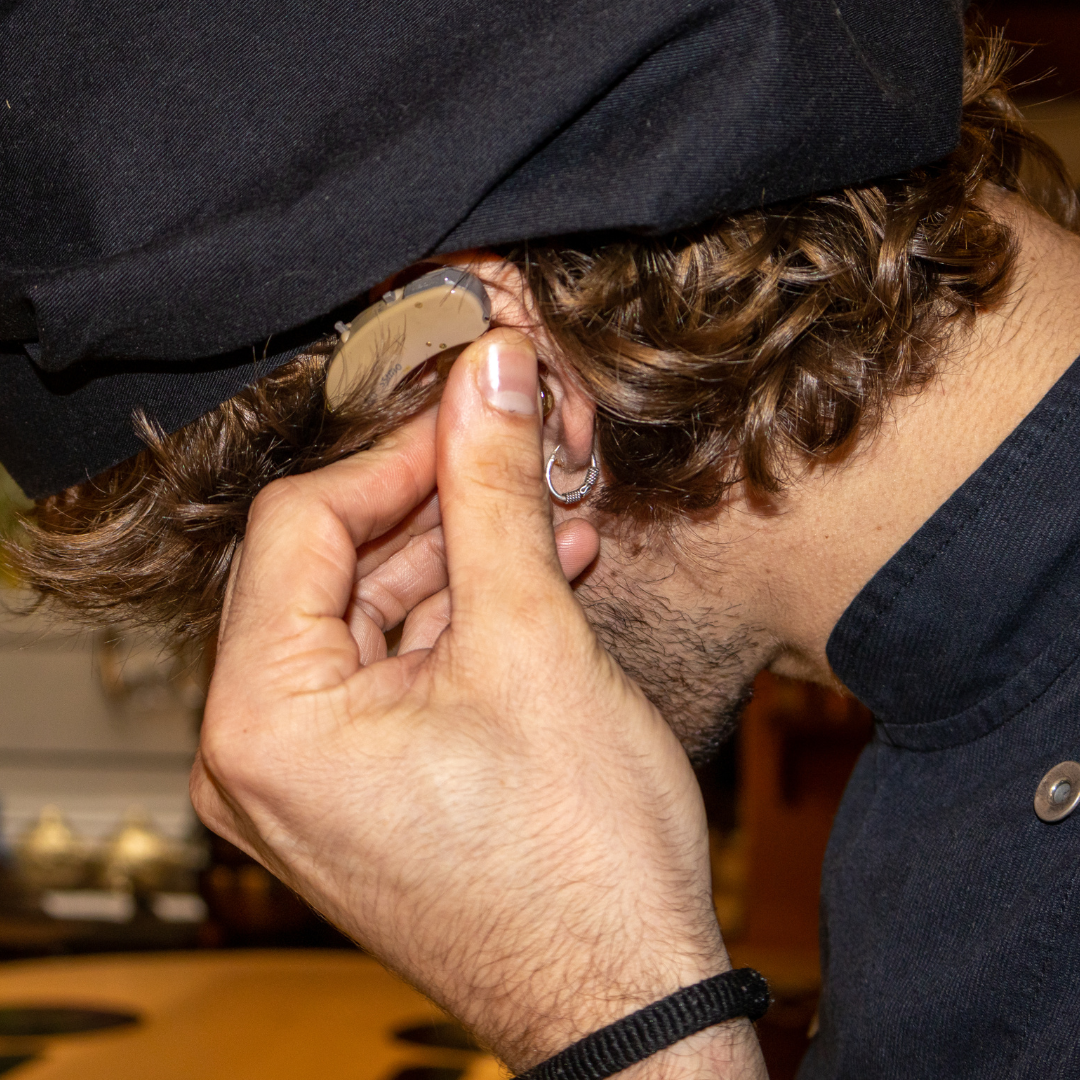
Following dinner conversations becomes challenging when high ambient noise interferes with your focus and hearing. We perform comprehensive diagnostic assessments to evaluate hearing in quiet rooms and challenging acoustic spaces to identify functional deficits. After uncovering the precise factors driving your difficult hearing, our team helps you select individualized auditory solutions.
Understanding the Contrast Between Quiet Hearing and Restaurant Noise
Calm domestic settings establish a positive signal-to-noise ratio, allowing target speech to stand out clearly from faint background noises. Modern restaurant environments create the complete opposite listening environment. Overlapping chatter, piped music, kitchen clatter, and hard-surface reverberation mask speech, forcing the brain to expend immense cognitive effort to track conversation.
This symptom pattern often reflects underlying high-frequency hearing loss, central processing dysfunction, or physiological aging of the auditory nerve. Attention, fatigue, dim lighting, and distance from the speaker may make it worse. Many individuals register normal audiometric thresholds on standard pure-tone screenings yet show profound deficits during speech-in-noise testing. Difficulty in restaurants deserves evaluation even when everyday hearing seems normal.
How Audiologists Identify High-Frequency Hearing Loss
Diagnostic assessment begins by documenting specific listening breakdowns, recreational noise exposure, tinnitus symptoms, medications, and hereditary auditory patterns.
Diagnostic pure-tone audiometry establishes the softest auditory thresholds you can perceive across standardized frequencies via air and bone conduction pathways. A clinical presentation of high-frequency loss produces a downward-sloping audiogram where auditory thresholds worsen significantly at higher frequencies. Supplementary assessments routinely include diagnostic tympanometry to analyze middle-ear status alongside word-recognition testing to determine speech clarity.
Because testing in a silent booth does not mirror real-life restaurant environments, speech-in-noise testing supplies vital diagnostic clarity. It evaluates sentence-level speech comprehension as competing background babble increases in volume. Collectively, these evaluations clarify if your challenges relate to raw audibility, phonetic clarity, signal-to-noise processing, or compound factors.
Understanding Auditory Processing Disorders in Noisy Environments
An auditory processing disorder affects how the central auditory nervous system interprets sound. The ears may detect tones at expected levels, but the brain may have difficulty organizing competing signals, distinguishing similar speech sounds, or following rapid conversation. Our clinical team starts by examining peripheral auditory thresholds, subsequently deciding if an auditory-processing test battery or multidisciplinary consultation is necessary.
What Strategies Can Improve Hearing in Noisy Environments?
Small changes can improve the signal reaching your ears and provide clearer visual cues. Before dining out, choose a quieter restaurant or visit during an off-peak time. Facilities equipped with upholstered booths, acoustic baffles, fabric curtains, carpeted floors, and soft materials prove far easier on hearing than minimalist, hard-tiled spaces.
At the restaurant:
- Ask host staff for a quiet table distanced from kitchen traffic, bar noise, audio speakers, and loud group tables.
- Situate yourself with a structural wall behind you to minimize distracting ambient noise from behind.
- Position yourself to directly face companions under bright lighting to enhance facial comprehension.
- Maintain the shortest comfortable physical distance between yourself and your conversation partner.
- Position your better-hearing ear directly toward your main conversational partner.
- Ask the speaker to rephrase the missed portion instead of repeating everything.
- Explicitly repeat back important logistical details instead of pretending you caught every word.
- Step away for a brief auditory rest when cognitive listening fatigue begins to set in.
- Request that dining partners articulate words distinctly at an unhurried, natural speed.
- Speaking with excessive volume creates acoustic distortion that fails to make words clearer.
Assistive Listening Technologies for Noisy Environments
Selecting the ideal assistive technology depends upon underlying diagnosis, specific acoustic challenges, and verified hearing loss. Advanced hearing aids utilize beamforming directional microphones, adaptive noise reduction, and specialized restaurant programs to elevate voices directly ahead while suppressing ambient chatter. Patients must uphold realistic expectations because modern amplification cannot strip out every ambient human voice completely.
Wireless remote microphones provide the most effective enhancement to real-world signal-to-noise ratios. The microphone is placed near or worn by the speaker and sends that voice directly to compatible hearing aids or another receiver. Direct audio routing minimizes the acoustic penalty of conversational distance and surrounding environmental din.
Supplementary auditory solutions include:
- Wireless conference table microphones that capture multi-speaker discussions
- Telecoils or hearing-loop systems in equipped venues
- Real-time smartphone speech-to-text transcription and live-captioning apps
- Over-the-counter hearables equipped with directional speech-enhancement algorithms
- Sound-level meter applications and community-driven quiet dining guides
We will help compare available technology, verify device compatibility, and instruct you on utilizing your selected hearing equipment.
The Clinical Role of Audiologists in Managing Loud Environments
A comprehensive hearing evaluation looks far beyond the common misconception of “I hear fine in quiet environments.” We can review the places, speakers, and noise levels that cause problems and select tests that reflect those concerns. Your comprehensive workup may involve pure-tone hearing thresholds, middle-ear testing, recorded word recognition, and speech-in-noise measures. Dedicated central auditory-processing testing will be scheduled if your history and primary diagnostic testing indicate central pathway issues.
Hearing changes that present abruptly, affect only one side, or progress rapidly necessitate consultation with an ear, nose, and throat physician. Individualized diagnostic care pinpoints the precise physiological etiology rather than merely blaming restaurant noise for communication struggles.
Contact Us for a Hearing Evaluation Today
If dining in loud spaces leaves you feeling isolated, fatigued, or guessing at missed speech, contact us to schedule a thorough hearing evaluation. We provide proven treatments to enhance your hearing in noisy environments, offering hearing aid fine-tuning, specialized assistive accessories, and individualized auditory therapy.
Reach out to our audiology clinic today to schedule an evaluation and begin enjoying clear, effortless conversations.